
Why sodium-ion?
Sodium-ion batteries work like lithium-ion: ions move between a cathode and an anode. But they use one of the most abundant elements on Earth, and that changes the cost, safety and supply story.
Built to stay calm under abuse.
Sodium-ion chemistry releases less heat in failure and is more thermally stable than many lithium chemistries. Our cells are tested well beyond normal use.
- Over-charge to 5.0 V with no fire and no explosion
- External short circuit (≤ 5 mΩ, 10 min) with no fire and no explosion
- Crush, drop, heavy impact and vibration tests passed
- 130 °C oven test held for 30 minutes with no fire and no explosion
- −40 °C to 85 °C thermal shock, 32 cycles
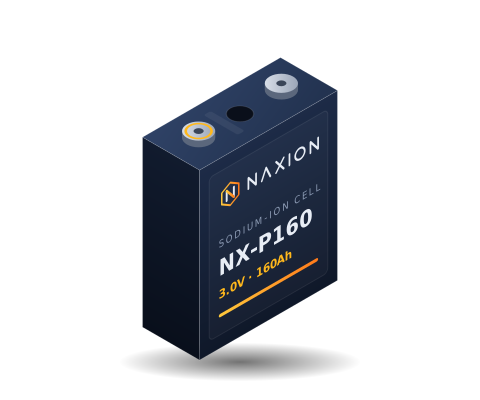
Sodium-ion vs LFP vs lead-acid
| Characteristic | Sodium-ion | Lithium iron phosphate (LFP) | Lead-acid (VRLA) |
|---|---|---|---|
| Cell energy density | 110 – 160 Wh/kg | 160 – 200 Wh/kg | 30 – 50 Wh/kg |
| Cycle life (80% EOL) | 4,000 – 10,000+ | 4,000 – 8,000 | 300 – 1,200 |
| Capacity at −20 °C | ≈ 90% | ≈ 60 – 70% | ≈ 50 – 60% |
| Lowest discharge temperature | −40 °C | −20 °C | −20 °C |
| Ship / store at 0 V | Yes | No | No |
| Critical minerals | None: sodium, iron, manganese, aluminium, hard carbon | Lithium, graphite | Lead |
| Current collectors | Aluminium (both electrodes) | Aluminium + copper | n/a |
| Thermal runaway risk | Low | Low – moderate | Low (hydrogen off-gassing) |
Typical industry values for comparison only. Performance varies by product and conditions.
When to choose sodium-ion
Stationary storage
Weight doesn't matter on a wall or in a cabinet, but cycle life, safety and cost per cycle do.
Harsh climates
From alpine winters to remote outback enclosures, there's less need for heating or cooling systems.
Lead-acid replacement
Sodium-ion's voltage window maps well to 12/24/48 V systems, with far longer life and less weight.
Supply-chain resilience
Less exposure to lithium price swings and critical-mineral constraints.
Not sure if sodium-ion suits your project?
Our engineers can review your load profile and environment and recommend the right chemistry, honestly.